
Publications

Vydáváme a překládáme knihy, příručky a brožury o Housing First a řešení bytové nouze. Kromě toho publikujeme i výsledky našich výzkumů: vyhodnocujeme funkčnost aktuálních i navrhovaných opatření nebo pravidelně mapujeme stav bytové nouze v Česku.

  • “There is no effective defense.” An investigation into uncertain rental relationships.

    “There is no effective defense.” An investigation into uncertain rental relationships.

    This publication is the result of a research into precarious tenancy relationships and their impact on specific households. At its core is qualitative research, which aims not only to identify the problems of risky tenancy and subletting relationships, but also to capture the emotions and experiences of the individual actors. Together with the respondents, we are trying to outline a path leading to stabilization and improvement of the situation.

    How was the research conducted?

    The research took the form of semi-structured interviews and focused on the situation in Plzeň and Ústí nad Labem, with several interviews conducted with actors operating nationwide. We chose these cities because of the specificity of the local housing market and the Platform’s existing ties there. Twenty-seven respondents participated in the research in order to obtain the broadest possible spectrum of views.

  • Summary analysis Rents, Energy, Taxes, Benefits, Public construction: Solutions to the Housing Crisis Exist

    Summary analysis Rents, Energy, Taxes, Benefits, Public construction: Solutions to the Housing Crisis Exist

    The Social Housing Platform has published a new comprehensive analysis focused on addressing the growing financial inaccessibility of housing in a situation where rental housing, which should be a flexible option, has become the main risk factor for income poverty among low- and middle-income households in the Czech Republic.

    The publication, entitled “Rents, Energy, Taxes, Benefits, Public Construction: Solutions to the Housing Crisis Exist,” is a comprehensive work by several entities that have been working in the field of housing for many years. The publication, entitled “Rents, Energy, Taxes, Benefits, Public Construction: Solutions to the Housing Crisis Exist,” is a comprehensive work by several entities that have long been involved in the housing sector and, within their areas of expertise, propose options for alleviating the housing crisis in the short term.

    The analysis quantifies various options that the state could use to significantly reduce the severity of the housing crisis during the current election period. A Europe-wide comparison shows that the crisis will not resolve itself and that an active role on the part of the state is essential. Analysts from the Platform for Social Housing, the Association for International Affairs, the Czech Tenants’ Association, PAQ Research, and the University of Ostrava have therefore selected and developed measures that we know would lead to an improvement in the situation within two years if approved. This is crucial because, although it makes sense to have a good building law, for example, any impact of new construction, even if well-targeted, will only be felt in ten years’ time, and yesterday was already too late.

  • How to deal with the housing crisis: Missing measures in election manifestos

    How to deal with the housing crisis: Missing measures in election manifestos

    At the Platform for Social Housing, we welcome the fact that socio-economic issues, and housing in particular, are playing a major role in this year’s pre-election debates in the Czech Republic. Housing has been such a politically neglected issue in our country for so long that almost any attention from the state can bring about improvement.

    At the same time, we recognize that many political promises offer simplistic and even harmful solutions that could ultimately exacerbate the housing crisis. We see this as a logical consequence of the fact that popular voter solutions unfortunately do not correspond to the reality of the housing crisis in the Czech Republic and its causes. It is understandable that in the current situation, everyone would ideally like to live in their own home, and building more apartments seems like a clear and straightforward way to achieve this. In this publication, we will attempt to demonstrate that there is unfortunately no such simple solution to the housing crisis and will focus on what would really help.
    The Platform for Social Housing has long focused on ending homelessness and housing emergencies as a whole, and the perspective of the analysis and the topics chosen correspond to our interest in this target group, which includes 161,000 people without a stable home.

    The text presents newly analyzed data from the Czech Statistical Office’s SILC dataset, which is the most representative data sample for measuring the financial situation of Czech households. The text also analyzes our own qualitative data from interviews conducted with various actors in the rental market as part of the Platform for Social Housing research project “Strengthening Rental Relationships of Households Living in Very Insecure and Unsuitable Housing.”

  • Jak zmírnit hlavní problémy dávkové reformy?

    Jak zmírnit hlavní problémy dávkové reformy?

    According to an analysis by the Social Housing Platform and the SPOT Center, Benefit reform – main problems and risks, the consequences of adopting the reform as proposed by the Ministry of Labor and Social Affairs would include:

    ● a deterioration in the availability of housing, especially for young people,

    ● a reduction in support for families with children, especially if they want to have a second child,

    ● a reduction in support for low-income workers (especially those in rented accommodation),

    ● an increase in poverty among families with children in rented accommodation, single mothers, and lonely senior citizens,

    ● a strengthening of the tendency for poor people to concentrate in municipalities and locations with cheap rent,

    ● limiting the possibility of settling down,

    ● limiting the possibility of debt relief/debt repayment.

    Czech Republic deserves a different, well-thought-out benefit reform that will work and will not ignore the most significant challenges facing our country. 

    This material takes into account the fact that MPs are not willing to return the reform to a comprehensive overhaul, as it deserves, and offers a way to mitigate the negative impacts described through adjustments that can be implemented during the discussion of the proposal in the Chamber of Deputies.

  • Benefit reform – main problems and risks

    Benefit reform – main problems and risks

    The proposed reform of the benefit system, which is currently (January 2025) being debated in the Chamber of Deputies of the Parliament of the Czech Republic, has fundamental shortcomings.

    As a result of insufficiently prepared analytical materials and a non-transparent and inadequately consulted preparation process, inappropriate structural elements have been incorporated into the proposal, which will lead to consequences that contradict the claims of its proponents.

  • Change in the culture of local governments

    Change in the culture of local governments

    The aim of the project was to understand the mechanisms of local government authorities so that, based on in-depth knowledge, solutions could be proposed to overcome the barriers to the current implementation and continuity of policies to end homelessness, which are subject to the current culture of the authority – customs, hierarchies, atmosphere, rituals, and overall functioning. We aimed the project at strengthening efforts to systematically and effectively prevent and end housing emergencies in the Czech Republic, especially in the 20 most affected municipalities, which account for more than 50% of housing emergencies in the Czech Republic.

    This work is licensed under a Creative Commons CC BY 4.0 license. For license terms, visit CC BY 4.0 Legal Notice | Attribution 4.0 International | Creative Commons.

  • Czech Republic at a crossroads: Report on Exclusion from Housing 2024
    Česko na křižovatce: Zpráva o vyloučení z bydlení 2024

    Czech Republic at a crossroads: Report on Exclusion from Housing 2024

    Almost one in seven citizens of the Czech Republic has housing problems. Senior citizens and children are among the most vulnerable, according to a new report by Za bydlení (For Housing).

    Housing problems and housing shortages continue to rise in the Czech Republic. Czechia is at a crossroads. Either it will pass the Housing Support Act and set out on the path to ending the housing crisis and poverty profiteering, or it will reject this law and the unnecessary suffering of children in housing crisis and the parasitism of poverty profiteers on the welfare system will continue. The government must do its homework and, in accordance with its Program Statement, adopt the Housing Support Act, which it has been working on for three years and which is supported by a wide range of key players. This is according to the Report on Exclusion from Housing for 2024, the main conclusions of which were presented by the Za bydlení (For Housing) initiative at a press conference in Prague on Tuesday, October 8. The report outlines the extent of the housing crisis, which it estimates affects approximately 161,000 people, including 62,000 children. According to the report, a total of 1.6 million Czech citizens have some kind of serious housing problem. It also describes how poverty profiteers are taking advantage of the housing crisis, the lack of prevention, and the current legislative vacuum. Specifically, it shows how the housing crisis affects children. The Housing Support Act, which experts say fully meets 8 out of 10 points of a good law for addressing the housing crisis, has meanwhile been “frozen” in its second reading in the Chamber of Deputies.

  • Brief summary of the main negative impacts of the benefit reform

    Brief summary of the main negative impacts of the benefit reform

    Calculations of the impact of the benefit reform based on five model examples show that the benefit reform, in its proposed parameters, particularly the normative housing costs, will have the following negative impacts on the population of the Czech Republic:

    1. Poor working families will only have enough to survive on, and the benefit system will cease to function as a tool for equalizing opportunities for children from poor families.
    2. There will be a significant increase in the risk of losing one’s home when losing one’s job.
    3. The effectiveness of housing benefits as the only effective tool for alleviating energy poverty among many senior citizens will deteriorate.

  • Leaflet: Follow-up study of the impact of Housing First on families with children in Brno after five years (2023)

    Leaflet: Follow-up study of the impact of Housing First on families with children in Brno after five years (2023)

    Between 2016 and 2018, the Rapid Re-Housing project piloted the Housing First concept, which was new to the Czech Republic at the time, on a target group of 50 families with children. The families were rented municipal apartments in Brno and were then provided with intensive support in settling in.

    The supported families spent seven times less time in housing emergency in the last five years. As of May 1, 2022, 73%, or 33 out of 45 surveyed intervention families, were living in adequate housing.

  • Follow-up study of the impact of Housing First on families with children in Brno after five years (2023)
    Publikace Dosledování dopafů Housing First

    Follow-up study of the impact of Housing First on families with children in Brno after five years (2023)

    Between 2016 and 2018, the Rapid Re-Housing project piloted the Housing First concept, which was new to the Czech Republic at the time, on a target group of 50 families with children. The families were rented municipal apartments in Brno and were then provided with intensive support in settling in.

    The supported families spent seven times less time in housing emergency in the last five years. As of May 1, 2022, 73%, or 33 out of 45 surveyed intervention families, were living in adequate housing.

  • Analysis of complaints filed against tenants of social housing owned by the City of Prague but not entrusted to municipal districts (2023)

    Analysis of complaints filed against tenants of social housing owned by the City of Prague but not entrusted to municipal districts (2023)

    Deputy Mayor Alexandra Udženija (ODS) repeatedly cites the increase in complaints about social housing tenants during the last election period as one of the main reasons why the current rules for renting municipal apartments need to be changed. In recent weeks, ahead of the expected discussion of the proposed new rental rules, articles have appeared in the media describing cases of inappropriate behavior by social housing tenants. These articles state that social housing, which focuses on the most vulnerable groups of the population, is almost automatically associated with inappropriate behavior, harassment of neighbors with disorder, noise, and/or odors, etc., and that living in an apartment building with one or more social housing units almost automatically means a significant reduction in quality of life.

    In our analysis, we would therefore like to show the results of the functioning of social housing residents in neighborhoods who are labeled in the articles as “unadaptable,” “homeless,” and “drug addicts.”

    Analysis of complaints filed against tenants of social housing owned by the City of Prague but not entrusted to municipal districts (PDF)

  • Energy for People: How to cope with an expensive winter with peace of mind? (2022)

    Energy for People: How to cope with an expensive winter with peace of mind? (2022)

    Food prices are rising. Rents are increasing, and on top of that, there has been a sharp rise in energy prices. Household energy expenses are rising significantly, and many people are thinking about how to reduce their consumption and save money in the coming months. Therefore, a coalition of non-profit organizations has compiled an overview of savings and options for requesting assistance from the state.

    Energy for People: How to cope with an expensive winter with peace of mind? (PDF)

  • Energy poverty and its solutions (2022)

    Energy poverty and its solutions (2022)

    The study Energy poverty and its solutions, jointly published by Hnutí DUHA, Platforma pro sociální bydlení (Platform for Social Housing) and the Za bydlení (For Housing) initiative, maps the extent of energy poverty, identifies its systemic causes, specifically vulnerable groups of the population, and possible solutions.

    Based on an analysis of data from 2021, the study clearly shows that energy poverty, i.e., a situation where a household spends disproportionately high amounts on energy and thus suffers in other areas of basic needs, is not a recent phenomenon in Czechia and that, on the contrary, it represents a serious structural problem that has been overlooked for a long time before it began to resonate throughout society in the context of the current unprecedented rise in energy prices.

    Energy poverty and its solutions (PDF)

    The project was supported by the OSF Foundation as part of the Active Citizens Fund program, which aims to support civil society and strengthen the capacities of non-profit organizations.

  • Methodology for external support for Housing First programs in the Czech Republic (2022)

    Methodology for external support for Housing First programs in the Czech Republic (2022)

    The publication is intended both for external support providers who provide support to multiple Housing First projects at once, and for the implementers of Housing First projects themselves. Implementers can use the methodology primarily as a guide and summary of information about the individual tools they can use in their work, but also as a checklist of tasks that need to be performed during project implementation.

    External support methodology (PDF)

    The methodology is the outcome of the project Supporting the Successful Dissemination of the Housing First Approach in the Czech Republic, which aims to contribute to the use of Housing First programs as a standard tool for reducing housing insecurity.

  • Social housing in the Czech Republic (2021)

    Social housing in the Czech Republic (2021)

    Report for the European Commission Representation in the Czech Republic, in which we present findings from research and mapping of social housing in the Czech Republic. Based on our own fieldwork and data collection, secondary data collection, and secondary research, we estimate the current extent and structure of homelessness and housing exclusion in the country, present relevant solutions and the extent to which they are used in the current policies and practices of 20 Czech cities. We present best practices from Czech cities and non-governmental non-profit organizations and propose recommendations for addressing the housing crisis in the Czech Republic.

    Social Housing in the Czech Republic – Full Report (PDF) Download

    The project was supported by the OSF Foundation as part of the Active Citizens Fund program, which aims to support civil society and strengthen the capacities of non-profit organizations. The program is financed by the EEA and Norway Grants.

  • Housing as a problem – Report on Exclusion from Housing (2021)

    Housing as a problem – Report on Exclusion from Housing (2021)

    The report summarizes the results of a six-month survey of the extent of housing insecurity in the Czech Republic, which we conducted from fall 2020 to spring 2021. However, this time we are not limiting ourselves to housing emergencies. We also address other major housing issues, such as the risk of losing one’s home, excessive housing costs, and the unavailability of housing, as well as the functioning of housing benefits as one of the key tools for addressing the financial unavailability of housing. Special attention is paid to the problems of senior citizens, as more and more older people are ending up in housing emergencies and a significant proportion of them are burdened by excessive housing costs.

    Housing as a problem (PDF)

  • Systemic solution to the housing emergency faced by families and individuals (2019)

    Systemic solution to the housing emergency faced by families and individuals (2019)

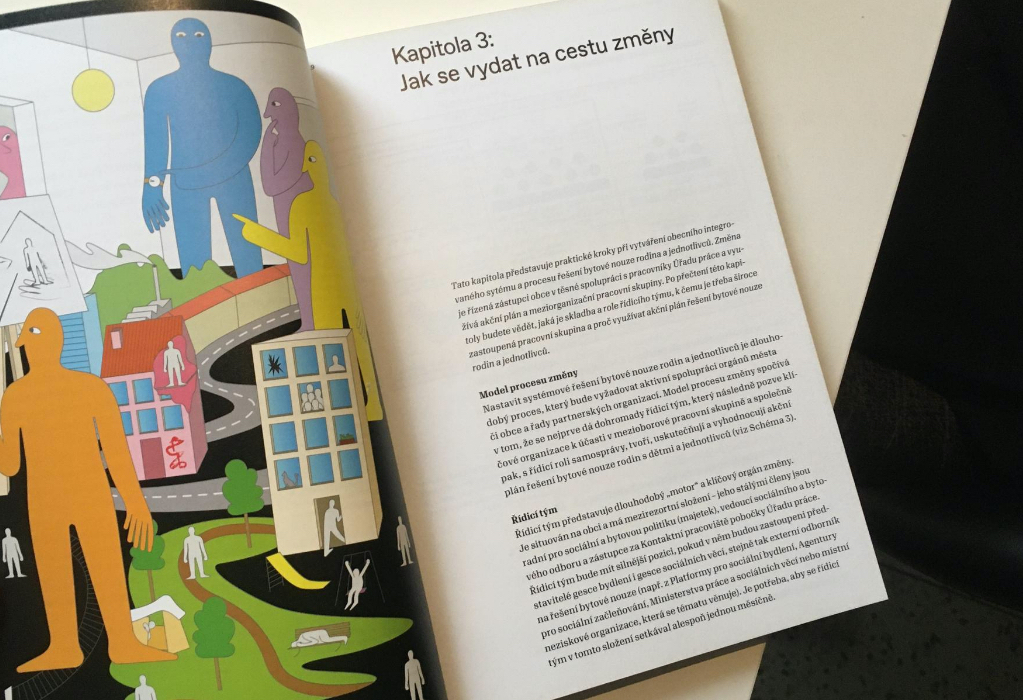
    In this publication, together with the R-Mosty organization and the Institute of Sociology of the Czech Academy of Sciences, we provide municipalities with comprehensive guidance and support on how to address housing emergencies in their areas. We introduce them to the vision of a new approach, with details of the innovative Municipal Integrated System model, and advise them on how to set up a management team and an interdisciplinary working group, and who should be part of it. In addition, we provide specific tools for addressing housing emergencies, complemented by practical experience and recommendations from municipalities in the Czech Republic and abroad where housing emergencies are being successfully addressed.

    Systemic solutions to the housing crisis affecting families and individuals at the municipal level (PDF)

    The publication was financed by the Operational Program Employment as part of the project Strengthening the Knowledge Base of Local Governments for Reducing and Ending Homelessness, registration number: CZ.03.3.X/0.0/0.0/15_124/0006486.

  • Report on Exclusion from Housing (2019)

    Report on Exclusion from Housing (2019)

    The Report on Exclusion from Housing is a regular publication in which we provide information on the housing emergency in Czech Republic, down to the level of individual municipalities with extended powers. It is the result of six months of intensive data collection and analysis from benefit systems, data obtained from dozens of municipalities based on requests under the Freedom of Information Act, data on thousands of clients of the largest social service providers in the Czech Republic (Salvation Army, Naděje, Slezská diakonie, People in Need) and data from the census of homeless households in Brno and Liberec.

    Report on Exclusion from Housing for 2018 (PDF) Download

  • Handbook for peer support in housing (2018)

    Handbook for peer support in housing (2018)

    We created this publication in collaboration with experts from the Czech Republic, Great Britain, Hungary, Finland, and Spain. Here we present the basic findings and practices in peer support for service users. In addition to answering the question “what is peer support and what can it offer for working with homeless people,” in this publication we seek to lead a broader discussion on the topic of peer support, provide research findings, and offer suggestions for the further development of peer support.

  • Handbook for Housing Support Workers (2018)

    Handbook for Housing Support Workers (2018)

    We created this publication in collaboration with experts from the Czech Republic, the United Kingdom, Hungary, Finland, and Spain. It is intended for social workers and aims to provide services supporting homeless people with suggestions and ideas on how to provide assistance more effectively and creatively.

  • European Handbook Housing First (2017)

    European Handbook Housing First (2017)

    We have secured the publication of the Czech translation of the European Housing First Handbook. The handbook is the result of the work of an expert panel composed of leading European researchers on the Housing First method. It is a practical and comprehensible information and training material. Funded by the City of Brno.

  • Ending housing emergencies for families and individuals (2016)

    Ending housing emergencies for families and individuals (2016)

    The publication presents the basics of the Housing First approach and a series of recommendations for the city of Brno, which has decided to try out new projects. The first chapter focuses on the development of Rapid Re-housing and Housing First models for ending homelessness, their basic building blocks, and their use in practice. The second and third chapters are edited contributions from the leading European expert on Housing First, Volker Busch-Geertsema, and the leading Czech expert, Jan Snopek, from a conference we organized in 2014. The fourth and fifth chapters are the outputs of leading global experts on housing emergencies and homelessness, whom Brno invited to assess the local situation and propose specific solutions.

  • Final evaluation report of the project “Supporting the successful dissemination of the Housing First approach in the Czech Republic” (2022)

    Final evaluation report of the project “Supporting the successful dissemination of the Housing First approach in the Czech Republic” (2022)

    The main objective of this evaluation report is to provide PSB advisors who have provided support to HF programs with as much relevant information as possible about the functioning of the HF programs receiving support and about factors that may influence the functioning of Housing First programs in the Czech Republic. Another objective of this evaluation report is to present the results of a subjective assessment of the support provided by the Platform for Social Housing to Housing First program implementers.

  • Methodological guide to public participation in addressing housing issues (2017)

    Methodological guide to public participation in addressing housing issues (2017)

    European organizations focused on eradicating poverty have long promoted the idea that the creation of social policies and their subsequent monitoring and evaluation should be a process based on ongoing dialogue with all stakeholders, including those who are the target groups of social inclusion policies. These are people who have experienced poverty and subsequent social exclusion, as well as homeless people and people living in substandard conditions. The publication is a guide to involving them in addressing the issue of housing emergency.

Newsletter

Pravidelné informace o našich aktivitách a také o problematice sociálního bydlení v Česku.